
RYA Radar course - General

Radar is an excellent item of kit to have on board a craft – but only if you really know how to maximise its potential. The one day RYA Radar course helps you to understand how radar works and make the most of it for collision avoidance and navigation.
Radar has a variety of uses including navigation and collision avoidance, indeed the ColRegs state that you must use all means available to you to avoid the possibility of a collision. Therefore, if your craft is fitted with a Radar then you must use it and by implication know how to use it to its full potential, getting the most from a radar is a matter of understanding its potential and being able to ‘set it up’ and modify the settings for the conditions you are experiencing.
Course Duration
1 day – The course runs from 9am to approximately 5pm
Instructor – student ratio
Typically 4 – 6 students per instructor.
The course suits….
A wide variety of boaters from those new to boating (sail and power) to those heading towards working commercially. The course is essential for anyone that has radar on board their vessel as it gives individuals the skills to be able to effectively understand the way their radar operates, the advantages and limitations of their radar’s features and how to navigation safely and use it for collision avoidance.
What does the simulator you use look like?
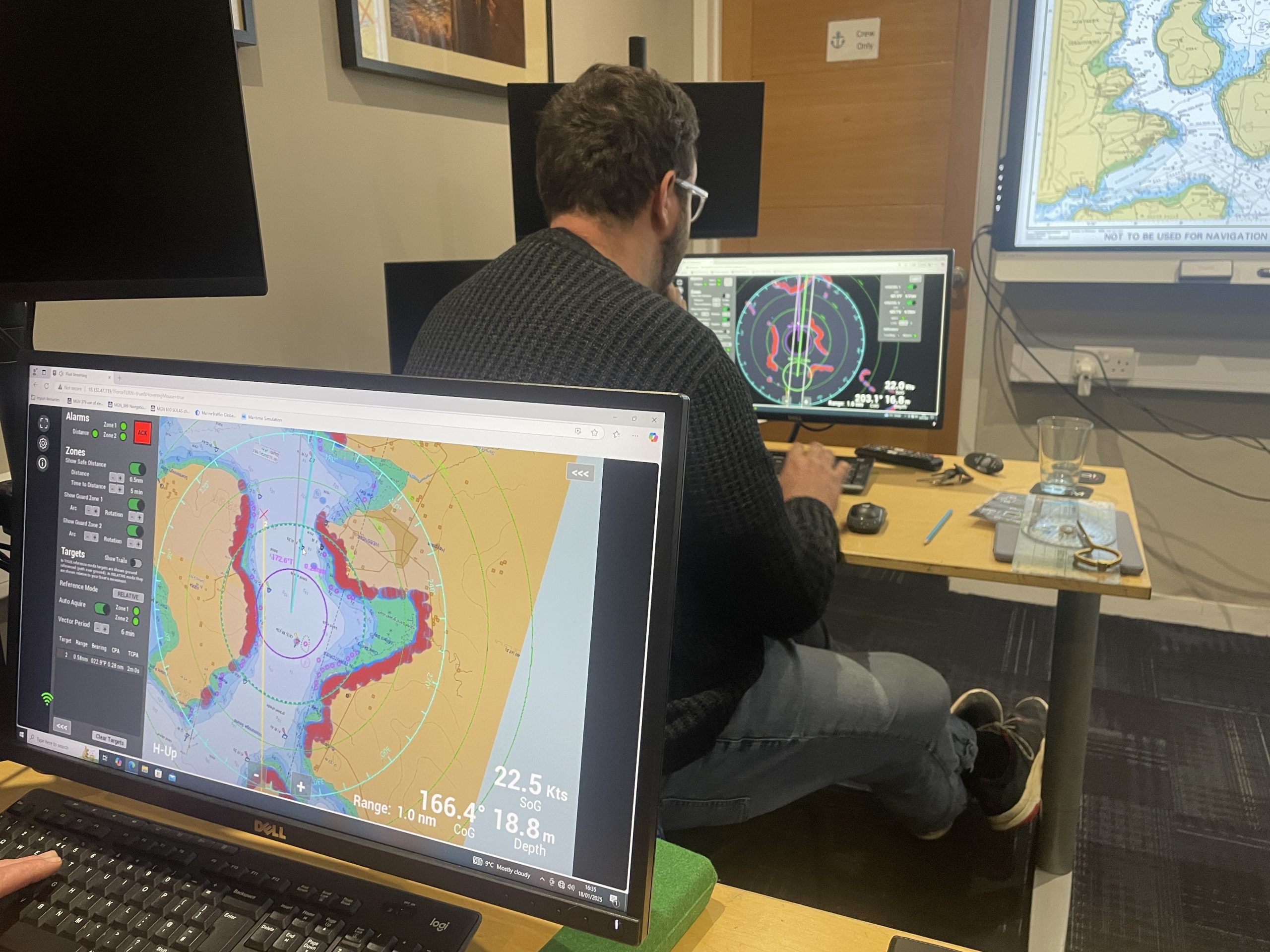
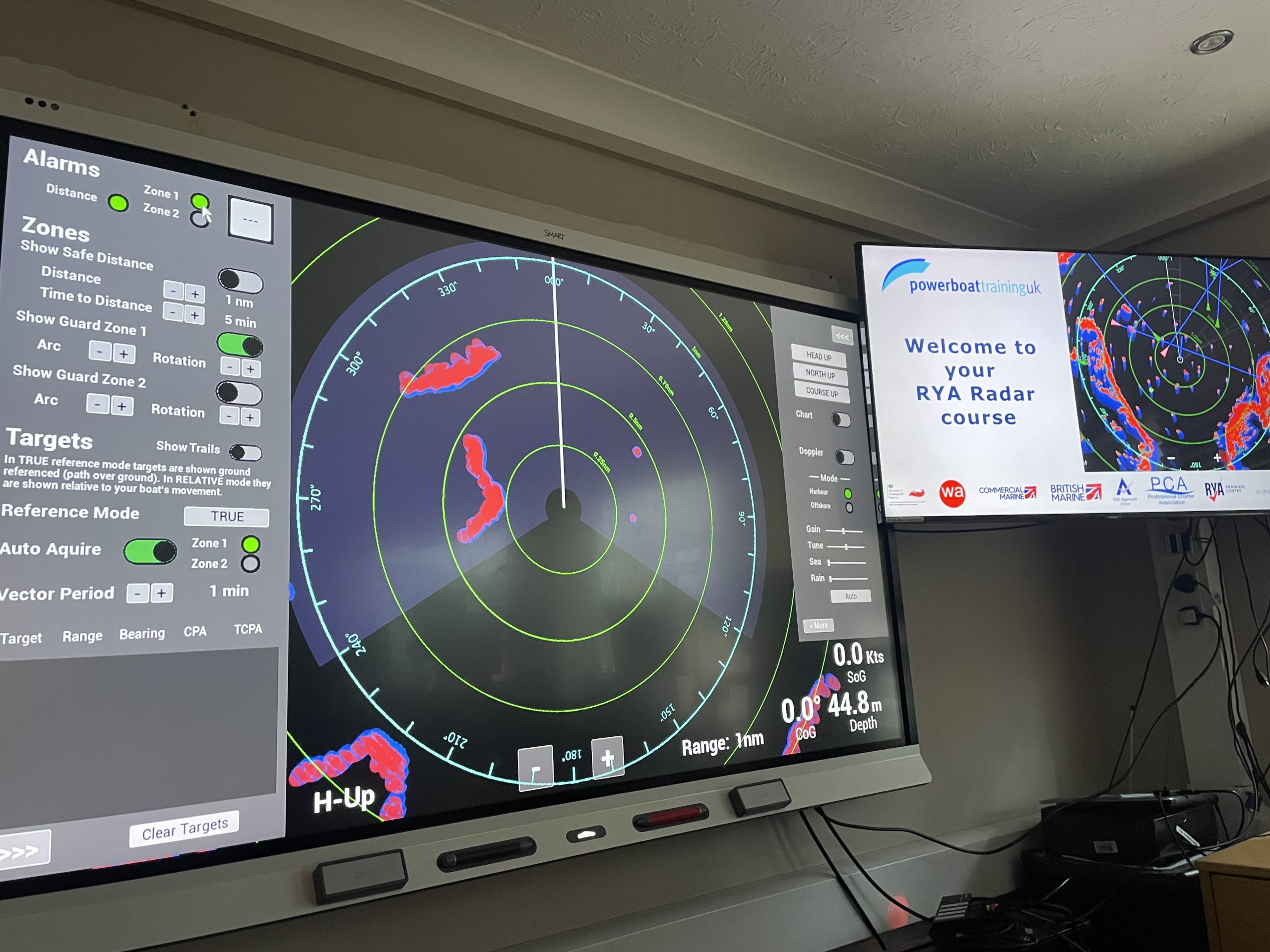
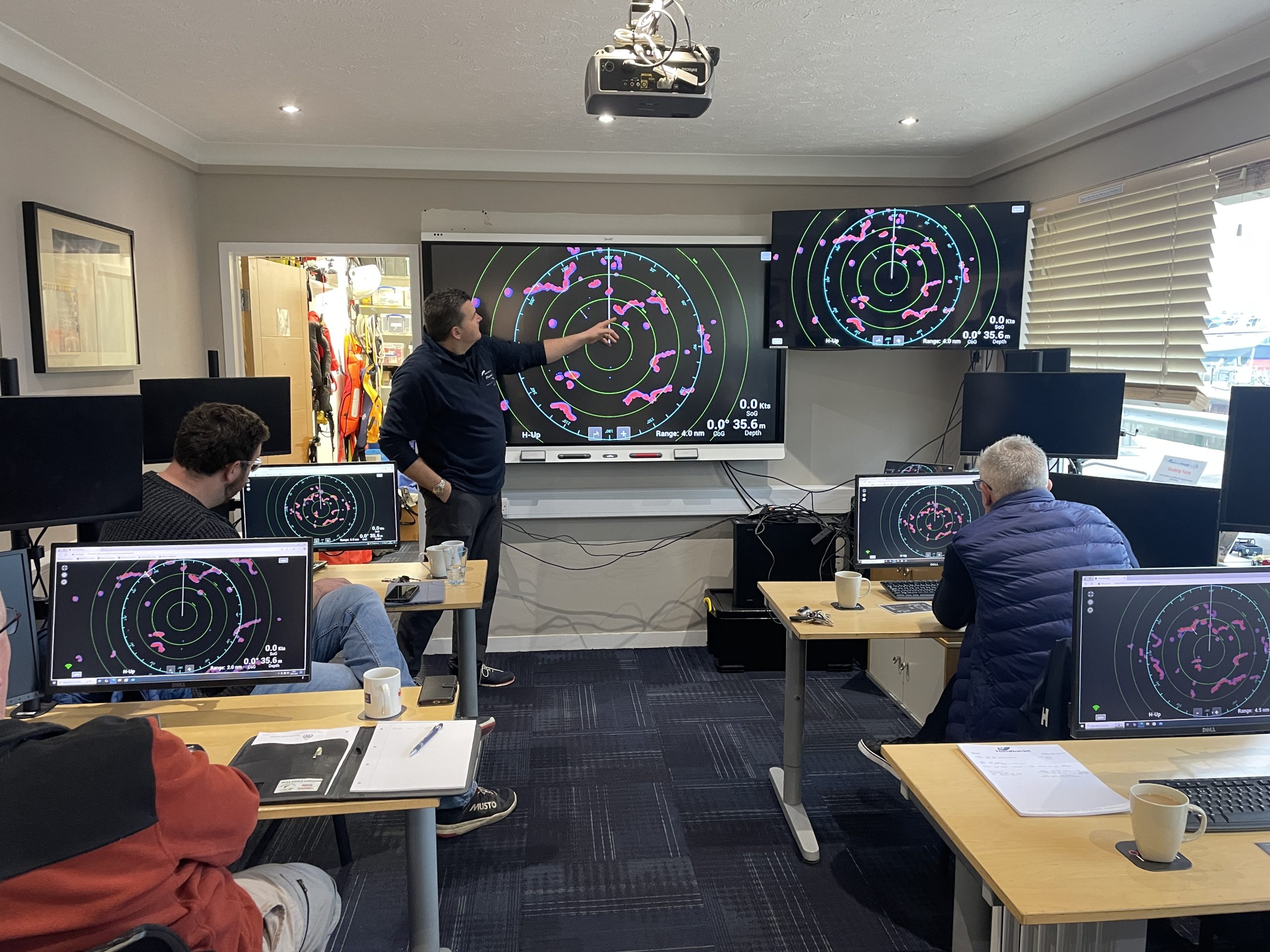
We use the new ‘state of the art’ simulator from Maritime Professional Development UK which replicates the operation of the current crop of sub 24m radars. It’s been developed to support the RYA Radar Course and includes 9 exercises which help students get real hands on experience of all of the features of the radar including navigating in restricted visibility. The final exercise brings all of what you have learnt together and we guarantee you’ll be amazed at how you safely and competently navigate through the training area in restricted visibility using all of the skills that you have developed through the individual exercises.
What does the radar course cover?
The RYA one-day Radar Course is designed to give boaters the essential knowledge and practical skills to use radar effectively for navigation and collision avoidance. Radar is a powerful tool, but without proper understanding, it can be misinterpreted or misused. This course bridges that gap by combining technical knowledge with hands-on experience, using a ‘state of the art’ radar simulator to replicate real-life scenarios.
The course begins with an introduction to how marine radar works, including basic principles with students learning how to switch on, tune, and adjust the radar for optimum performance, including using controls such as gain, clutter, and range scales.
A major part of the course focuses on interpreting radar images and identifying land, buoys, and other vessels. You’ll learn how to apply radar for collision avoidance by acquiring targets, determining the closest point of approach (CPA) and time to CPA (TCPA), and taking appropriate action under the Collision Regulations (COLREGs).
The course also covers radar navigation techniques, such as parallel indexing, using VRMs/EBLs (Variable Range Markers and Electronic Bearing Lines), and fixing position using transits and ranges. By the end, students will feel confident using radar in poor visibility and busy waters, making it an invaluable skill for both leisure and commercial skippers.
Why choose Powerboat Training UK for your radar course?
The simple answer is our instructors. Our instructors have current, real, hands on experience of using radar in fast and slower power driven vessels and vessels on passage under sail all over the world and their experience of using the the radar for collision avoidance and and for navigation makes for a really beneficial and enjoyable course.
As a professional full time school our classrooms are well equipped and dedicated to the running of these courses so have all of the materials expected so that we can run first rate courses.
Updated: November 2025
RYA Radar course - This course is aimed at
The RYA one-day Radar Course using Maritime Professional Development UK’s new radar simulator for the RYA Radar Course is designed for anyone who goes to sea and wants to understand how radar can be used safely and effectively for navigation and collision avoidance. Although the course is open to all leisure and professional mariners, it is particularly aimed at skippers and crew of powered and sailing vessels who operate in coastal or inshore waters where visibility, traffic density, or navigational complexity make radar an important safety tool.
Typical candidates include RYA Day Skipper and Coastal Skipper students, yacht owners, powerboat helms, commercial crew and those preparing for a commercial endorsement or higher-level qualification such as Yachtmaster or Advanced Powerboat. It is also valuable for crew on motor cruisers, fishing vessels, pilot boats, survey craft and Superyachts, where radar is in regular use and a professional standard of watchkeeping is expected.
The course is particularly beneficial for learners who have little or no radar experience, or for those who have used radar before but never had formal training. Many skippers rely on radar, AIS, chartplotters or mobile apps without fully understanding radar’s strengths, limitations, or how to interpret targets correctly. The simulator enables students to build real competence without the restrictions of time, weather or vessel availability. It allows repeated practice of radar set-ups, target aquisition manually and automatically, CPA/TCPA interpretation, and collision-avoidance decision-making in a controlled, realistic environment.
By using the new radar simulator, students experience vessel movements with multiple targets, course and speed vectors, VRMs/EBLs and parallel indexing exactly as they would appear on a real display. This makes the course ideal for those who want hands-on, practical learning rather than just theory.
In short, the course is aimed at any skipper or crew member who wants to improve safety, confidence and navigational awareness at sea, and who recognises radar as a key piece of modern marine electronics that should be understood—not just switched on.
RYA Radar course - Syllabus
The aim of the course is to teach students to use small boat Radar to assist decision making in navigation, pilotage and collision avoidance.
1. Switching on and setting up.
Knowledge of:.
1.1 How a radar set measures distance
1.2 How a radar set measures bearings
1.3 The main components of a small craft radar installation
Understands:
1.4 The limitations imposed by the power, antenna size and display of typical small-craft radar
Can:
1.5 Switch on a typical small-craft radar set and adjust its brightness, gain, range and tuning
2. Understanding the picture
Knowledge of:
2.1 How antenna size affects beam width
2.2 The differences between solid state and magnetron antennas
2.3 The benefits of the doppler setting
2.4 The factors that determine the strength of echo returned by a target
2.5 The use of radar overlay over charts
2.6 Effect of Propagation conditions.
Understands:
2.7 The effect of beam width on discrimination
2.8 The effect of pulse length on discrimination
2.9 The effect of false echoes, echoe stretch, blind arcs, shadow sectors and radar horizon
3. Optimising the display settings
Knowledge of:
3.1 The cause and cure for sea and rain clutter
3.2 The use of preset modes
3.3 The cause and cure for interference
Understands:
3.5 The risks associated with clutter clearance tools
3.6 The difference between head-up, course-up and north-up modes including stabilisation
3.7 How to use radar to monitor the performance of GNSS, heading sensor alignment and identify gyro error
3.8 Radar to radar interference
Can:
3.8 Adjust the sea clutter and rain clutter controls to suit prevailing conditions
3.9 Identify whether a radar is in head-up or north-up mode
3.10 Interpret radar screen images to identify errors and possible rectification
4. Radar Reflectors
Knowledge of:
4.1 How radar cross section is measured
4.2 Types of passive reflector in common use (octahedral, stacked, array, lens)
4.3 Types of active reflector in common use and the requirement to also carry a passive reflector
4.4 Types of AtoN and SAR in use (RTE, Racon, SART)
Understands:
4.5 The limitations of passive radar reflectors
Can:
4.6 Recognise a SART on the radar screen and respond accordingly
4.7 Identify a RACON buoy as an aid to navigation
5. Monitoring position by radar
Knowledge of:
5.1 The principles of a three point fix
5.2 Selecting discernible landmarks for a three point fix
Understands:
5.3 How to take and plot a position fix using the EBL
5.4 Limitations of the EBL for position fixing
5.5 How to combine EBL, VRM and other techniques to position fix
Can:
5.6 Plot the vessel’s position on a chart by using the VRM
6. Pilotage by Radar
Knowledge of:
6.1 “Eyeball” pilotage by radar
6.2 The limitations of “eyeball” pilotage
Understands:
6.3 The principle of parallel indexing (PI)
6.4 The principle and limitations of using VRMs in lieu of PIs
Can:
6.5 Prepare and execute a simple pilotage plan using clearing ranges, back bearings and parallel indexing
7. Collision avoidance
Knowledge of:
7.1 The principles of relative motion and Radar plotting
7.2 The existence and use of automatic radar plotting aids including possible errors in calculation and interpretation
7.3 The use of relative and true vectors and trails
Understands:
7.4 The implications of IRPCS rules 5 (look-out), 6 (safe-speed), 7 (risk of collision) and 19 (restricted visibility)
7.5 The practical limitations of small craft radar
7.6 The use of AIS as an aid to situational awareness and the limitations of AIS in determining the risk of collision
Can:
7.7 Assess the risk of collision with another vessel
7.8 Assess the closest point of approach of another vessel, the time to CPA and determine whether it will pass ahead or astern
7.9 Assess the course and speed of another vessel
7.10 Take appropriate action to avoid a collision
RYA Radar course - Gallery



RYA Radar course - Book Now
Thank you for your interest in this course.
Hopefully the dates that we have scheduled work well with your availability. If the dates don’t quite work then we are always keen to be as flexible as possible so please contact us and we’ll see what we can do.
We’re always really keen to chat to you when you’re booking a course as whilst we are happy to take bookings through this system for your convenience – nothing beats chatting about boats and courses!
Don’t forget too that if you are an individual or company/organisation booking a few people onto courses then we may be able to schedule dates around you. Equally, for bookings some time in the future we can usually juggle our course dates if what we have scheduled doesn’t quite work for you.
| Date | Duration | Location | Availability | |
|---|---|---|---|---|
| Sat 28 Mar 2026 | 1 day | Southampton | 4 spaces | Book now |
| Sat 11 Apr 2026 | 1 day | Poole | 6 spaces | Book now |
| Sat 25 Apr 2026 | 1 day | Southampton | 6 spaces | Book now |
| Sat 09 May 2026 | 1 day | Poole | 6 spaces | Book now |
| Sat 30 May 2026 | 1 day | Southampton | 6 spaces | Book now |
| Sat 13 Jun 2026 | 1 day | Poole | 6 spaces | Book now |
| Sat 27 Jun 2026 | 1 day | Southampton | 6 spaces | Book now |
| Sat 11 Jul 2026 | 1 day | Poole | 6 spaces | Book now |
| Sun 26 Jul 2026 | 1 day | Southampton | 6 spaces | Book now |
| Sat 08 Aug 2026 | 1 day | Poole | 6 spaces | Book now |
| Sun 23 Aug 2026 | 1 day | Southampton | 6 spaces | Book now |
| Sat 05 Sep 2026 | 1 day | Poole | 6 spaces | Book now |
| Sat 26 Sep 2026 | 1 day | Southampton | 6 spaces | Book now |
| Sat 03 Oct 2026 | 1 day | Poole | 6 spaces | Book now |
| Sun 18 Oct 2026 | 1 day | Southampton | 6 spaces | Book now |
| Sat 14 Nov 2026 | 1 day | Poole | 6 spaces | Book now |
| Sat 28 Nov 2026 | 1 day | Southampton | 6 spaces | Book now |
Courses run in Southampton are run by our partner school Aboard Boat Coaching.
Also…We have an automatic cutoff built into this system that doesn’t allow you to book within 48 hours of the course starting. We may still have places though – use the contact button to alert us to your interest.
And finally…Once you have finished the process you will receive a variety of emails. If you do not get any then please check your spam folder and if there is nothing there then please let us know.
